• Skip to main content

Adaptfolio

We deliver tailored Customer Success strategies and implementation, enabling businesses to achieve customer experience excellence and elevate client engagement while streamlining Customer Operations and optimizing CRM systems to deliver measurable results.

  • Home
  • About
  • Blog
    • Customer Retention
    • Customer Expansion
    • CSM Best Practices
  • Contact

Blog

Jul 05 2026

Creating Greater Visibility Into At Risk Accounts Through a Strategic CSM Slack Channel

One of the most important parts of Customer Success is identifying risk early enough to do something about it.

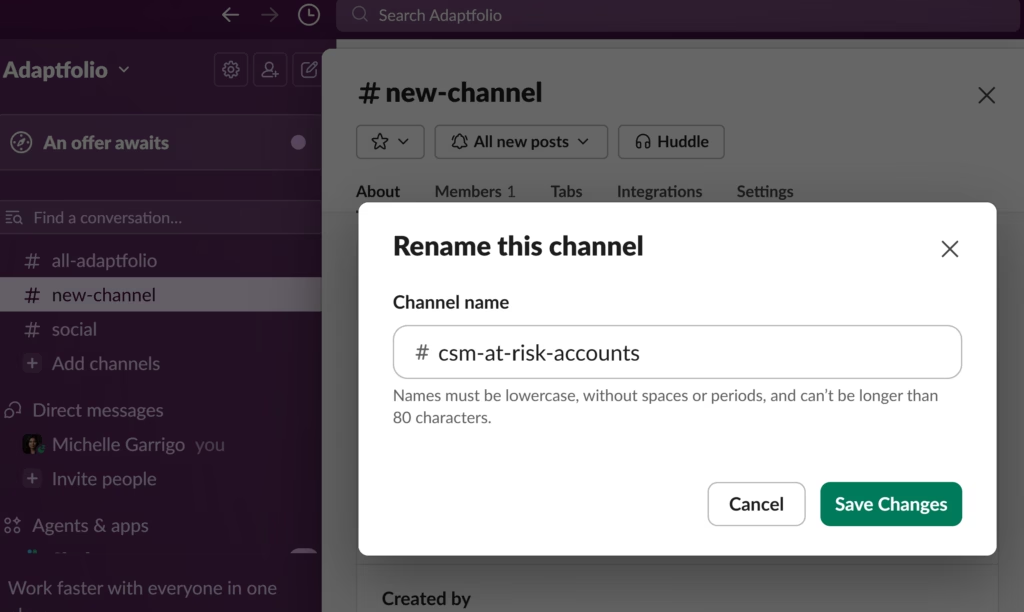
Too often, account risk becomes visible only when renewal is already close, usage has declined, or the customer has become disengaged. To help create more proactive visibility, I created a dedicated Slack channel designed to surface accounts that may be showing early signs of renewal risk due to low adoption, underutilization, or stalled engagement.

The purpose of the channel is simple: bring the right people together earlier, create shared visibility, and support CSMs in moving accounts back toward a healthier path before renewal conversations begin. This initiative is not just about tracking risk. It is about creating a stronger rhythm of collaboration across the team. By giving CSMs a clear space to flag concerns, document account context, and ask for support, the channel helps reduce silos and makes it easier for cross functional teammates to understand where they can help.

How the Channel Works

CSMs post one thread per account so that all updates, context, questions, and next steps stay organized in one place. The parent message includes a clear account snapshot. From there, teammates can reply directly in the thread and tag the right people, whether that is an AE, manager, product partner, solutions consultant, enablement lead, or another stakeholder who can help move the account forward.

Each thread is intended to make three things clear:

  • What is already being done
  • Where additional support is needed
  • What may be blocked or slowing progress

I have shared my template below that you to leverage! 

Using Slack Canvas to Keep the Process Consistent

To make the channel easy to use and scalable, I also used Slack Canvas to house the account risk template directly within the channel. This gives CSMs a consistent structure to follow without having to recreate the format each time. The Canvas acts as a simple playbook and reference point. It outlines what information should be included in each account thread and helps ensure that every post has enough context for others to quickly understand the situation and contribute meaningfully.

This structure makes the channel more than a place for updates. It turns it into a working space for account planning, collaboration, and risk recovery.
Sample Account Thread Template

  • At Risk Account Name: [Customer Name]
  • Segment or Tier: [Enterprise / Strategic / Growth / Other]
  • CSM: [Name]
  • Current Contract Value: [$]
  • Adoption or Utilization Health: [% or general status based on company metrics]
  • Recent Usage Trend: [High / Moderate / Low / Declining]
  • Renewal Date: [Date]
  • Summary: [One line explaining the risk]
  • Action Items:
    • [Action] | Owner: [Name] | Due Date: [Date]
    • [Action] | Owner: [Name] | Due Date: [Date]
  • Help Needed [Decision needed, product insight, executive support, enablement resource, account strategy input, or ownership clarification]

Every Customer Success organization approaches risk management a little differently, but the goal is always the same: identify risk early enough to change the outcome. By creating a dedicated space for visibility, collaboration, and shared ownership, we’ve been able to make proactive account management part of our team’s everyday workflow and get the help of everyone in the organization. It takes a village to save an at-risk account, am I right?

Curious, how’s your team identify and collaborate on at-risk accounts? Do you use Slack, your CRM, Customer Success platform, or another process? Share your approach in the comments. I’d love to learn what’s working for your team.


Written by Michelle Garrigo · Categorized: Blog · Tagged: CSM Best Practices, Strategy

Jun 29 2026

How AI Is Actually Changing the Work of a CSM (From Someone In It)

There’s a lot of noise right now about AI “transforming customer success,” but most of what I see online feels abstract. The reality in day-to-day work is much more practical…and honestly, more interesting.

As someone actively working in customer success, I’ve been spending a lot of time figuring out what actually helps versus what just adds another layer of complexity.  Two things have stood out recently: how we’re using data more deeply through tools like Hex, and how quickly AI agents are starting to shift internal workflows.

Beyond my own experiments, I’ve been paying attention to how other customer success managers are using AI in practice. The patterns are surprisingly consistent:

1. Reducing admin overload. The biggest immediate win is time. Call notes, follow-ups, CRM updates, and tasks that used to quietly eat up hours each week are being partially automated or at least streamlined. That time goes back into actual customer engagement.

2. Improving the quality of conversations. AI isn’t just speeding things up; it’s improving preparation. Instead of walking into calls with generic account summaries, CSMs are walking in with clearer insight into what actually matters to the customer, how they’re tracking against it, and where opportunities exist.

3. Surfacing risk and opportunity earlier. Signals that used to be buried, like subtle usage drops or changes in product behavior are now easier to catch. That means fewer surprises and more proactive intervention.

Talking about signals and indicators – Have you tried out Hex Threads

My go-to for AI data has been HEX. One of the most useful changes in my workflow lately has been using Hex Threads. If your company already uses Hex and you’re in a CSM role but don’t yet have access, it’s worth asking for it directly. It’s one of those things that quietly unlocks a lot more context than you realize you were missing.

Having the ability to drill into account-level and user-level behavior changes the quality of your conversations in a very real way. Another thing I’ve learned: there are often advanced permissions in Hex that aren’t automatically exposed. If you’re in CS and only seeing surface-level data, ask about deeper access!

You can also connect Hex to Claude and start building your client facing QBRs.

Experimenting with AI agents for smoother handoffs

Lately, I’ve been experimenting with Claude-based coworking tools to build lightweight agents that help with internal handoffs, especially from Sales to CS and AE teams. One early use case I tested was creating a simple agent that summarizes sales context into something a CSM or AE can actually use. Instead of digging through long email threads or scattered notes, the agent pulls together key details like:

  • Customer goals discussed during sales cycles
  • Key stakeholders and their priorities
  • Any early risk signals or expectations set pre-sale

It’s still early, but even in its basic form, it has already reduced the “translation layer” that usually happens when accounts move from Sales into post-sale ownership

I’m still early in my own experimentation with AI agents in Claude Cowork, and I’m very curious how others are integrating these tools into their workflows.

Are you seeing similar shifts in your CS teams? What’s actually sticking versus what’s still just hype?

Written by Michelle Garrigo · Categorized: Blog · Tagged: CSM Best Practices

Jun 24 2026

Building Confidence and Connection: Women in Revenue

Career growth does not happen in isolation.

It happens through conversations, community, mentorship, shared lessons, and the encouragement of people who understand the path you are on. That is one of the many reasons I am grateful to be part of Women in Revenue, a community created to support women in revenue generating roles across Sales, Marketing, Revenue Operations, and Customer Success.

For anyone building a career in Customer Success, this kind of community can be incredibly valuable. Whether you are a new CSM trying to find your footing, an experienced CSM looking to expand your network, or a Customer Success leader navigating your next stage of growth, Women in Revenue offers a space to connect, learn, and feel supported.

A Community Built for Women in Revenue Generating Roles

Women in Revenue brings together professionals across the full go to market engine. That includes women working in sales, marketing, customer success, revenue operations, leadership, enablement, and other roles that directly contribute to business growth. What makes the community special is that it is not just about networking for the sake of networking. It is about creating access. Access to people. Access to mentorship. Access to resources. Access to conversations that help women grow with more confidence and clarity.

Why Customer Success Professionals Should Join

Customer Success can be an exciting career path, but it can also feel overwhelming at different stages. New CSMs may be learning how to manage customer relationships, run business reviews, understand product adoption, and communicate value. Mid career CSMs may be thinking about how to move into enterprise accounts, strategic roles, leadership, or customer success operations. Senior CS professionals may be looking for peer conversations around team building, executive presence, revenue impact, and career advancement. Women in Revenue creates space for all of these stages.

Participation in Women in Revenue

I participate in Women in Revenue by supporting women in revenue generating roles through mentorship and guidance, with the goal of helping others grow in their careers. As well, I gain so much learnings and knowledge from others in the space.

For me, mentorship is not about having all the answers. It is about sharing what I have learned, helping others think through their next steps, and creating a space where people feel encouraged and capable. Sometimes that means helping someone understand how to position their experience. Sometimes it means talking through Customer Success career paths, stakeholder management, confidence, leadership, or how to show business impact in a role.

Being part of this work is meaningful because I believe women in revenue roles deserve strong networks, practical support, and more opportunities to grow into the careers and leadership roles they are capable of pursuing.

Join Women in Revenue

I highly encourage you to explore Women in Revenue and consider joining. And if you are in Customer Success specifically, the dedicated Customer Success Slack channel is a great place to start. 

Join the community here: https://womeninrevenue.org/

Written by Michelle Garrigo · Categorized: Blog · Tagged: CSM Best Practices

May 04 2026

6 Questions Every Customer Success Manager Should Be Asking

In Customer Success, feedback is everywhere but insight is not. Clients will often share opinions, concerns, or requests, but if you stop at surface-level feedback, you risk missing what really matters the why behind their decisions, the outcomes they care about, and the value they expect from your partnership. The reality is that most of the feedback you hear comes from your loudest or least satisfied customers, which is why strong Customer Success Managers go deeper and ask intentional questions that uncover real business objectives and opportunities to deliver impact. The following questions are ones that I have personally asked and have worked the best for me!

1. What was the initial business problem that led you to buy our product?

This question may seem simple, but it gets directly to the core of why the customer signed in the first place. It helps reframe your product as part of a broader business solution and invites the client to think about the impact on their overall success. If the deal was recently closed, it is helpful to align with the Account Executive first so the client does not have to repeat themselves and you can build a more meaningful conversation from the start.

2. Are you achieving the outcomes you invested in our product for? If not, what could we be better at? 

The  question here helps you assess whether your product is truly delivering value. It shifts the focus away from features and toward outcomes that matter, such as helping your customer succeed internally or demonstrate impact to leadership. It also highlights areas for improvement without getting stuck on smaller feature requests that do not move the needle.

3. Which key performance indicators have our product helped you improve? 

Results matter, and this question ensures you are aligned on what success actually looks like. Even if KPIs were not clearly defined during onboarding, it is never too late to revisit them. This not only validates your impact but also creates an opportunity to showcase measurable value. Strong responses here can often be turned into powerful case studies for your organization.

4. On a scale from 1 to 10, how likely are you to renew today and what factors influenced your score? 

This is a direct way to gauge retention risk and overall sentiment. The key is to ask it early enough in the relationship so you have time to act on the feedback. Asking around the midpoint of the contract allows you to make meaningful adjustments and improve the customer experience before renewal becomes urgent. The follow-up question is where the real insight comes from.

5. Which feature do you find most valuable and why? 

Understanding what your customer values most allows you to reinforce what is working and identify what drives long term adoption. In many cases, a single feature can play a major role in renewal decisions. This insight is also valuable across teams, helping inform product development and messaging based on what truly resonates with customers.

6. What are some of the biggest pain points your business unit is encountering as it grows? 

This question positions you as a strategic partner rather than just a vendor. By understanding broader challenges, you can proactively align your product and recommendations to support their growth. It also opens the door to thoughtful expansion opportunities that are rooted in real customer needs rather than sales pressure.

Asking strong questions is only part of the role, what truly matters is how you use the answers. Applying these insights allows you to refine your approach, improve outcomes, and deliver greater value in every interaction. Just as important, sharing these insights across your organization helps strengthen product, marketing, and overall customer experience.

Written by Michelle Garrigo · Categorized: Blog · Tagged: CSM Best Practices, Customer Expansion

May 03 2026

Why CSMs Need to Go Beyond Surface Level Client Feedback

One thing I have learned in Customer Success is that customers do not always tell us the full story right away. How many times do you hear clients say everything is fine, but usage is dropping? Or they say they are happy, but they are not bringing new stakeholders into the conversation? That is why CSMs can’t rely only on surface level feedback.

As both a CSM and CSM leader, I have learned that some of the most important customer insights come from asking one more question, listening closely to what is not being said, and taking the time to understand the bigger picture.

Let’s workshop an example together. Let’s say a customer has let you know that the product is not working for their team. But what does that really mean?

  • Is the product not solving the problem they expected it to solve?
  • Was the team not properly enabled?
  • Did their priorities change?
  • Is there a new stakeholder involved who does not understand the value yet?
  • Was there a gap between what they expected during the sales process and what they experienced after implementation?

That deeper context matters. When we only respond to the first piece of feedback, we may solve the wrong problem. But when we slow down and ask better questions, we can start to understand what is actually happening.

Written by Michelle Garrigo · Categorized: Blog · Tagged: Customer Retention, Strategy

  • Page 1
  • Page 2
  • Go to Next Page »
  • Contact

Copyright © 2026 · Altitude Pro on Genesis Framework · WordPress · Log in